Fed Up with Narcos, Townspeople Take Up Arms in Guerrero
by Ezequiel Flores Contrera, Proceso
January 9, 2013
 |
| Photo: Ezequiel Flores |
Chilpancingo, Guerrero (apro). Five days
ago, inhabitants of Ayutla de los Libres and members of the Community Police
took over public security in this municipality located in the Costa Chica region
with the goal of expelling organized crime groups that have devastated the
region.
This incident once again demonstrates
the lack of authority and the government's indifference towards the levels of
impunity and violence that persist in the area.
Citizens are fed up with the incessant
wave of murders, extortion, and kidnappings, which has set off a series of
social movements, mainly in the la Montaña region, where armed townspeople seek
to lock up organized criminal gangs, a situation that has shed light on alleged
links between local authorities and criminals.
Last year, inhabitants of the
municipalities of Huamuxtitlán, Xochihuetlán, Cualac, and Olinalá decided to arm
themselves in order to kick out the criminals that operated with impunity in
that zone in the la Montaña region.
Now, that same phenomenon is repeating
itself in Ayutla de los Libres, the place where on March 1, 1854, the Ayutla
Plan was proclaimed by Florencio Villareal and Juan N. Álvarez to disavow
Antonio López de Santa Anna as president of the country.
A series of extortions and kidnappings
came to a head on Saturday, January 5, when Eusebio Alberto Alvarado García,
commissioner of the town of Rancho Nuevo in the Tecoanapa municipality, was
kidnapped, according to official reports.
Immediately, close to 400 townspeople
from three municipalities, Tecoanapa, Ayutla de los Libres, and Florencio
Villareal, with the support from members of the Community Police, mobilized to
rescue the commissioner.
Due to the fact that they put up
checkpoints along the federal highway that joins these municipalities in the
Costa Chica region, Alvarado García was freed and the kidnappers fled.
Notwithstanding, the townspeople and
members of the Community Police maintained the checkpoint in Ayutla and, on
Sunday, January 6, they shot a taxi driver who refused to be searched, according
to the state Attorney General's Office.
The justice agency opened a criminal
investigation into the death of 40-year-old Cutberto Luna Chávez.
Notwithstanding, on Tuesday, January 8,
governor Ángel Aguirre justified the Ayutla townspeople's actions, stating that
armed self-defense "sheds light on citizens' desperation with organized crime
and the absence of a response from the authorities," according to local
media.
Some 200 armed civilians currently
maintain a checkpoint at the entrance and exit of the municipal seat of Ayutla
de los Libres and they claim they will not leave until they permanently drive
out members of criminal groups that operate in the zone.
*************
The Example of Armed Self-Defense Spreads in Guerrero Communities
- The protection measures prove the government's failure against organized crime, says NGO
- Local groups say that Governor Aguirre Rivero doesn't listen to them nor does he follow through
by Sergio Ocampo Arista, La Jornada
 |
| Nahuas from about 30 communities created the Popular Citizens Police this past December 2 in Temalcatzingo, Olinalá municipality, in the Montaña Alta. Photo: Sergio Ocampo |
Chilpancingo, Guerrero, Janurary 12.
Dozens of communities in the la Montaña and Costa Chica regions of Guerrero have
once again become the scene for actions of armed self-defense due to a lack of
response from the three levels of government to deal with the people's demands
for security against the organized crime that operates in those two regions in
the southeastern part of the state, where Me'pha (Tlapaneco), Ñuu savi
(Mixteco), and Amusgo indigenous peoples and Afro-Mexicans live.
Led mainly by contingents from the Union
of Peoples and Organizations of the State of Guerrero (Upoeg in its Spanish
initials), the communities joined the movement of citizens who are tired of
crime, violations, and extortion at the hands of criminal groups.
Vidulfo Rosales Sierra of the
Tlachinollan Montaña Regional Human Rights Center spoke about the causes of the
popular uprising that began on January 6 in the municipal seat of Ayutla de los
Libres following the kidnapping of Eusebio Álvarez Mendoza, a rancher and
commissioner of the Rancho Nuevo community in the Tecoanapa municipality: "That
is due to a vacuum of federal and local authority in the exercise of their
functions in public security."
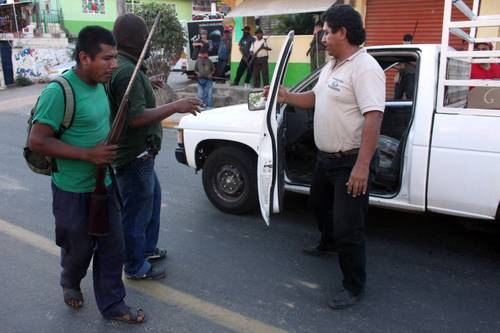 |
| Townspeople from Ayutla de los
Libres in the Costa Chica work a checkpoint installed in the Guerrero municipality without the Community Police. Photo: Lenin Ocampo Torres |
Without doubt, he added, "the security model and
its policies have failed; regarding Operation Safe Guerrero, it's important to
remember that last year it was in effect, but there weren't considerable
advances. What is happening is proof that the criminals were not apprehended
nor did it have an impact on crime levels in that zone; on the contrary,
[organized crime] was strengthened."
Rosales Sierra complained, "It can't be
possible that peasants who are organized with low-calibre guns are standing up
to the criminals in a matter of two days, while the Army, the Navy, and police
with high-powered weapons haven't had an impact in three years; that is
impossible, it doesn't merit further analysis. That indicates that there is a
high level of complicity and a total lack of authority; for example, the state
Attorney General's Office does nothing, it knows about the relationships its
police force has and it refuses to remove its personnel, and here we see the
consequences."
He insisted that it is evident that
"there is a high level of coexistence and complicity between the state
authorities such as the Ministerial Police and the state police assigned to the
El Limón community in Ayutla with the public prosecutors and judges which
generated an environment that allowed organized crime to freely move in those
places as if they were at home. All of that complicity allowed crime to reign
and abuse the population."
That vacuum created by the government
led to locals organizing themselves. "The people were fed up and decided to
take security into their own hands, to rescue the principles of justice for the
indigenous and mestizo peasants."
Perhaps the most important part of this
popular uprising is that it demonstrates to Mexico that organized crime is not
invincible and that once the people organize, they can keep crime in check, and
that society shouldn't be paralyzed by the scourge "as they did these past
months in the municipalities of Huamuxtitlán, Cualac, and Olinalá."
But he warned that "when the people
return to their communities, [criminal groups] could react and put the safety of
the peasants and their families at risk. We will be watching to see how the
authorities react, because this is not about sending in more police."
He proposed that the peasants strengthen
themselves and respect "the systems of uses and customs [traditional indigenous
governance], to resume the peoples' traditional justice systems, and to not
simply organize in the heat of the moment without creating their own justice
institutions to avoid that crime threatens them."
The Organizing Process
The first manifestation of the
organization of the indigenous, mestizo, and Afro-Mexican peoples was the
creation of the Regional Coordinating Body of Community Authorities-Community
Police (CRAC-PC) in October of 1995; the municipalities of Huamuztitlán followed
their example this past September 17 with their Popular Citizens Police (PCP),
as did thirty Nahua towns in Temalacatzingo in the Olinalá municipality this
past December 2.
 |
| One of the almost 300
volunteer guards from the town of Tecoanapa, in the Costa Chica region. Photo: Lenin Ocampo Torres |
In Huamuxtitlán
the PCP was created with over 100 members on September 17, 2012, following the
kidnapping of 18 people by an organized crime group. Guerrero's ex-Attorney
General, Alberto López Rosas, was even given a file with over thirty violent
crimes, including the kidnapping of former mayor Juan Carlos Jiménez, murders of
taxi drivers, the appearance of cadavers in the municipal seat, home burglaries
and stolen cars, extortion of business owners, and alleged threats to the
ex-mayor Soledad Romero and her husband Víctor Echeverría Valenzuela, a former
leader of the teachers union.
On November 25, over 200 Mixteco
peasants from at least 30 communities in the Ayutla de los Libres municipality
were sworn in as new members of the Community Police to combat organized
crime.
With the Mixteco communities joining the
CRAC, its territory has grown to 107 towns in thirteen municipalities in Costa
Chica and la Montaña: San Luis Acatlán, Marquelia, Metlatónoc, Cochoapa El
Grande, Iliatenco, Malinaltepec, Altamajalcingo del Monte, Tlapa, Tlacoapa,
Acatepec, Ayutla, Azoyú, and Tlacoachistlahuaca.
The municipalities that have joined the
Popular Citizens Police are Huamuxtitlán, Cualac, and Olinalá, which are on the
border with the states of Morelos and Puebla.
Over a Year Without a Meeting
Valentín Hernández, the CRAC's legal
advisor, recalls that almost as soon as Governor Ángel Aguirre Rivero took
office on April 1, 2011, they requested a meeting with him, "and it wasn't until
May 28, 2012, when CRAC was given its one and only meeting, although afterwards
there have been a few meetings with the compañeros with the goal of following up
on the demands that were presented, which have only been minimally
fulfilled."
He stated that the governor has not
complied with the agreements that have been reached, "he only granted a budget
of $500,000 pesos, which was given in very small payments; they only gave part
of the 500 radios that they had promised, and beyond that, nothing, no uniforms,
no weapons, no rations, no vehicles. As a result of this breach of agreement,
we give him the authority that someone who makes promises and doesn't follow
through deserves."
He believes that the governor's
indifference contrasts with how the towns of Ayutla and Tecoanapa have treated
the uprising, which Upoeg is leading. "Some of these issues have been raised in
the Community Police assemblies, and others have come out in the media. We
don't care if attention is payed to other groups as long as it isn't detrimental
to the CRAC's demands and organizing process.
"We've seen that while spaces for
dialogue and fulfillment of agreements have been closed to the CRAC, other
groups where the Community Police has a presence are given full support; this
makes it clear that the rumors that have been circulating since December 22 when
the regional coordinators and commanders were appointed in the El Paraíso House
of Justice in Ayutla de los Libres are true: that the Upoeg is practically
working with the state government."
"What's happening in Ayutla," he
stressed, "is proof of that. If you analyze the declarations the Upoeg has made
this past week, it's clear that they were behind the uprising from the
beginning, and that they are even inviting towns from the region, including
those that belong to the CRAC, to join their movement."
Nonetheless, Valentín Hernández
announced that CRAC will soon announce its official position. "There was
already a meeting where it was agreed that a position that has been condensed
upon between the coordinators and the council members will be given, and we'll
probably emit a formal communique on Monday."
Regarding the presence of organized
crime in the communities that belong to the CRAC's houses of justice located in
San Luis Acatlán, Espino Blanco in the Malinaltepec municipality, and
Zitlaltepec in the Metlatónoc municipality, "there's tranquility, although we
are on alert due to the situation in Ayutla, it's business as usual."
According to the lawyer from
Tlachinollan, Aguirre Rivero has had a very distinct attitude towards the CRAC:
"the insensitivity and lack of interest in the people's normative systems is
plainly evident. The government has distain for the CRAC's normative system,
when it is a model that could put security back on track and show us how to
resolve the problem of insecurity."
Instead, he insisted, the government,
far from addressing problems, has criminalized social struggle, "it has designed
and maintained the peoples in oblivion, and now it's going to have to face the
problem because it's just around the corner and it has to deal with the
communities' uprising, because it has to respond to this problem that
demonstrates the failures of the state's justice system."

No comments:
Post a Comment